
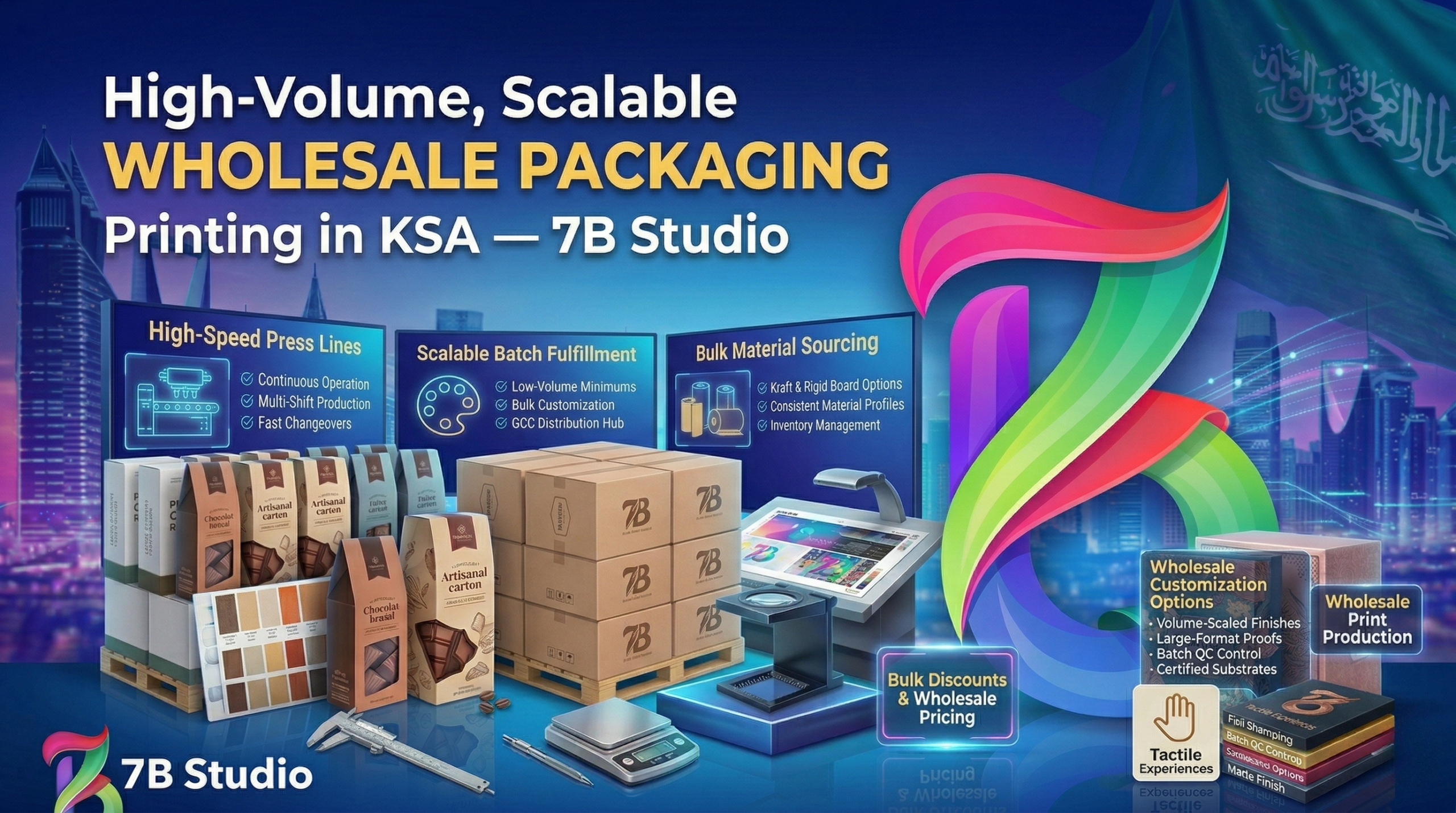
How to Get Wholesale Packaging Printing in Saudi Arabia: MOQs, Materials & Pricing Explained
To successfully secure wholesale packaging printing in Saudi Arabia, businesses must evaluate minimum order quantities (MOQs), choose appropriate materials like corrugated or folding cartons, and select cost-effective printing methods such as offset or digital. Ordering in bulk significantly reduces the per-unit cost for mass delivery across Riyadh, Jeddah, and Dammam.
Finding high-quality, cost-effective packaging is a massive pain point for rapidly growing businesses across the Kingdom. When you rely on small, fragmented print runs, your per-unit costs skyrocket, aggressively eating into your hard-earned profit margins. However, navigating the complex world of industrial printing—with its strict minimums, technical jargon, and opaque pricing structures—can feel incredibly overwhelming for local procurement teams.
This comprehensive guide completely demystifies the process of securing wholesale packaging printing in Saudi Arabia. We will thoroughly explain exactly how to navigate factory MOQs, select the perfect sustainable materials, and accurately forecast your commercial printing costs. Whether your fulfillment center is located in Riyadh, Jeddah, or Dammam, mastering these wholesale procurement strategies will drastically lower your overhead and protect your bottom line.
What Is Wholesale Packaging Printing and Why Does It Matter for Saudi Businesses?
Understanding the fundamental mechanics of industrial printing is the first step toward optimizing your supply chain. Wholesale procurement operates on entirely different rules than standard, short-run commercial printing.
Wholesale printing vs retail printing: understanding the difference
Retail printing caters specifically to small businesses needing a few hundred boxes, utilizing digital presses with zero setup fees but high per-unit costs. Conversely, wholesale packaging printing relies on massive, traditional industrial machinery designed for immense economies of scale. By manufacturing thousands of units simultaneously, the factory effectively absorbs the heavy initial setup costs, drastically lowering your final price per box.
Why Saudi businesses are switching to wholesale packaging orders
Driven heavily by the ambitious manufacturing goals of Vision 2030, the local commercial landscape is expanding rapidly. Consequently, Saudi enterprises are scaling their operations and abandoning expensive, short-run digital orders. Transitioning to a bulk packaging printing strategy allows local brands to secure vastly better pricing, guarantee inventory stability during peak seasons, and maintain strict, unwavering brand consistency.
Who needs wholesale packaging printing in Saudi Arabia? (industries overview)
Virtually every rapidly scaling commercial sector in the Kingdom requires massive, reliable physical packaging solutions to survive.
- FMCG and Food Brands: Require thousands of FDA-approved folding cartons and flexible pouches weekly.
- Pharmaceutical Companies: Demand highly secure, tamper-evident mono cartons in massive regulatory-compliant batches.
- E-commerce Retailers: Need thousands of durable corrugated shipping boxes to fulfill daily nationwide online orders.
Types of Wholesale Packaging Printing Available in Saudi Arabia
To optimize your fulfillment line, you must deliberately choose the specific structural style that matches your exact operational workflow.
Corrugated box printing (3-ply, 5-ply and 7-ply)
Corrugated shipping boxes are the undisputed workhorses of the Saudi logistics network. A standard 3-ply structure works perfectly for lightweight consumer goods, while 5-ply and 7-ply configurations provide massive vertical stacking strength for heavy industrial shipments. Consequently, ordering these highly durable cartons wholesale is mandatory for any serious e-commerce operation.
Folding carton and mono carton packaging printing
Folding cartons utilize thin, highly flexible paperboard, making them the absolute industry standard for retail shelves. They ship completely flat to save massive warehouse space and fold together seamlessly on the assembly line. Therefore, they are universally utilized for cosmetics, food products, and lightweight retail merchandise.
Flexible packaging printing (pouches, films and laminates)
Flexible packaging is rapidly dominating the Saudi food and beverage sector. This category includes highly durable, airtight stand-up pouches and laminated film rolls used for snack foods and coffee. Furthermore, flexible packaging requires significantly less raw material to manufacture, making it an incredibly cost-effective wholesale option.
Rigid and luxury box printing (gift, magnetic and drawer boxes)
Rigid boxes represent the absolute pinnacle of luxury physical presentation in the modern commercial market. Built from highly condensed, unbending paperboard, they are strictly reserved for high-end perfumes, jewelry, and VIP corporate gifts. Because they require intense manual labor to assemble, wholesale ordering is the only way to keep per-unit costs manageable.
Paper bag and kraft bag printing wholesale
Custom printed shopping bags act as highly mobile, walking billboards for your specific retail enterprise. Procuring massive wholesale volumes of branded kraft bags or premium laminated paper bags ensures your retail boutiques never run out of critical customer supplies during busy holiday shopping seasons.
Printing Methods Used in Wholesale Packaging Printing
Selecting the correct commercial ink application method heavily dictates both your final visual quality and your overall invoice.
Offset printing: best for high-volume, colour-accurate wholesale orders
Offset printing utilizes custom-etched aluminum plates to transfer exact Pantone (PMS) ink colors onto the paper. It offers the absolute highest possible image quality and flawless color consistency. Consequently, it is incredibly cost-effective for massive wholesale runs, making it the primary choice for established Saudi retail brands.
Digital printing: flexible runs with fast turnaround
Modern digital presses completely eliminate the massive mechanical setup times associated with traditional offset manufacturing. While generally used for shorter runs, industrial digital printers can handle medium wholesale batches effectively. Therefore, digital printing offers incredible operational agility for brands launching rapid, seasonal marketing campaigns.
Flexographic printing for flexible and film packaging
Flexographic printing utilizes flexible, custom-made rubber plates to stamp liquid ink directly onto raw substrates at incredibly high speeds. It remains the absolute most common and cost-effective manufacturing method for massive, high-volume corrugated shipping cartons and flexible film rolls across the Kingdom.
UV and screen printing for specialty packaging
UV printing utilizes highly specialized liquid inks that cure instantly under ultraviolet light, creating incredibly sharp, vibrant imagery on unusual substrates like plastic or foil. Screen printing forces heavy ink through a mesh stencil, resulting in unparalleled color density. Consequently, these methods are reserved for highly specialized, premium wholesale orders.
Offset vs digital printing for wholesale packaging: which should you choose?
If you are ordering 5,000 or more folding cartons and require exact corporate color matching, offset printing is undeniably your best option. However, if you need 1,000 boxes delivered by next week and your design features highly complex, varying photographic imagery, industrial digital printing will serve your needs perfectly.
Packaging Materials: What to Use for Wholesale Printing
The physical rigidity of your packaging communicates immense psychological weight and financial stability to the recipient.
Corrugated cardboard: types, flute grades and print compatibility
Corrugated board strength is determined by its internal wavy “flute.” E-flute provides a highly smooth, thin profile that prints beautifully for retail mailer boxes. Conversely, thicker B-flute or C-flute boards provide massive structural rigidity, making them the industry standard for heavy-duty regional shipping across the Saudi desert.
Paperboard and folding carton stocks (250–400 GSM explained)
Paperboard thickness is measured in Grams per Square Meter (GSM). A lightweight 250 GSM stock is highly economical for small pharmaceutical boxes. However, upgrading to a sturdy 350 or 400 GSM stock provides a firm, premium snap that instantly impresses high-level corporate buyers. Consequently, selecting the correct GSM balances structural safety with procurement budgets.
Kraft paper: eco-friendly packaging material for sustainable brands
Unbleached brown kraft paper offers a rustic, highly environmentally conscious aesthetic that modern consumers increasingly demand. Furthermore, utilizing highly sustainable kraft materials actively aligns your enterprise with the green initiatives outlined in Vision 2030.
Rigid board and art board for premium and luxury packaging
Rigid board (often 800 to 1200 GSM) is incredibly thick and completely inflexible. Manufacturers wrap this heavy core with high-quality, beautifully printed “art paper” to create luxury gift boxes. Therefore, this premium combination is strictly mandatory for executives attempting to project immense financial stability.
Flexible films, laminates and pouches: material guide for food and FMCG
Flexible films utilize multiple ultra-thin layers of plastic and aluminum foil laminated together. This complex structural barrier completely blocks oxygen, moisture, and UV light from degrading the food products inside. Consequently, utilizing advanced laminates extends the shelf life of Saudi FMCG products drastically.
Finishing Options for Wholesale Packaging Printing
The chemical coating applied to your printed materials drastically alters both long-term durability and the initial tactile perception.
Matte and gloss lamination: protection and brand feel
Matte lamination provides a highly smooth, completely non-reflective surface that exudes quiet corporate sophistication. Conversely, a high-gloss coating makes colorful brand logos appear incredibly vibrant and adds immense physical durability against moisture. Therefore, both laminations provide vital physical protection for your wholesale boxes.
Spot UV coating: highlighting logos and premium design elements
Spot UV applies a thick, clear, high-gloss liquid polymer strictly to highly specific areas of your graphic design. This technique makes elements like your corporate logo shine brilliantly against a contrasting, flat matte background. Consequently, this intense visual contrast commands immediate consumer attention.
Foil stamping (gold and silver): adding luxury to wholesale packaging
Foil stamping presses ultra-thin layers of highly reflective, real metal directly into the paper stock. Adding elegant gold or silver foil typically doubles the baseline price of your commercial printing order but drastically elevates perceived value. Therefore, it remains the ultimate status symbol for high-end luxury Saudi brands.
Embossing and debossing for tactile brand identity
Embossing physically raises your corporate logo off the paper surface, creating a stunning, three-dimensional tactile effect. This highly specialized tooling process provides an undeniably prestigious, sculptural quality to your corporate packaging that standard flat ink cannot replicate.
Die-cutting and custom shapes: standing out on the shelf
Die-cutting requires a custom metal blade to punch out highly specific structural shapes or window panels from the raw cardboard. This specialized commercial tooling process instantly separates your brand from the endless sea of traditional rectangular boxes on the Saudi retail shelf.
MOQs for Wholesale Packaging Printing: What to Expect
Navigating the commercial procurement process requires a clear, highly realistic understanding of standard factory manufacturing constraints.
What is MOQ in packaging printing and why does it exist?
Minimum Order Quantity (MOQ) is the absolute lowest number of units a manufacturer is willing to produce in a single production run. It exists because commercial offset presses require massive amounts of labor and expensive metal plates just to calibrate the machine. Running fewer units than the MOQ simply forces the factory to operate at a financial loss.
Typical MOQ ranges by packaging type in Saudi Arabia
To budget effectively, you must understand standard local thresholds:
- Corrugated Shipping Boxes: Typically 1,000 to 3,000 units.
- Folding Cartons: Generally 3,000 to 5,000 units.
- Rigid Luxury Boxes: Usually 500 to 1,000 units (due to heavy manual labor).
- Flexible Pouches: Frequently 10,000+ units per specific design.
How printing method affects your minimum order quantity
Traditional offset and flexographic printing require massive MOQs to justify their heavy mechanical setup times. Conversely, because modern digital printing requires zero metal plates, agile local manufacturers can frequently offer much lower MOQs, sometimes starting at just 250 units for specific box styles.
How to negotiate better MOQs with packaging suppliers in KSA
If you cannot meet the strict MOQ, you can strategically negotiate with local Saudi suppliers. Offer to pay a slightly higher per-unit premium for a smaller run, or combine multiple different artwork designs onto a single, massive master paper sheet. Consequently, building a strong, long-term relationship with a local vendor frequently unlocks flexible MOQ terms.
Wholesale Packaging Printing Prices: A Realistic Guide
Factors that affect wholesale packaging printing prices in KSA
Custom packaging pricing is highly dynamic and depends entirely on a specific combination of variables. The raw material thickness, the total structural dimensions, the number of applied chemical finishes, and the total ordered quantity collectively dictate your final commercial invoice.
How finishing options add to your packaging printing cost
Applying highly complex finishes like spot UV coating or gold foil stamping adds entirely separate manufacturing steps and specialized manual labor to your order. Each additional pass through the commercial printing press heavily increases your overall production invoice. Therefore, utilizing a clean, minimalist design is the fastest way to reduce costs.
How to reduce per-unit costs with larger wholesale volumes
The absolute most effective strategy for securing massive commercial value is deeply leveraging the powerful economies of scale. Increasing your total order from 1,000 to 5,000 units frequently slashes your individual per-unit cost by over fifty percent, as the heavy initial machine setup fees are distributed much wider.
Artwork and File Setup for Wholesale Packaging Printing
Accepted file formats: AI, PDF, PSD and what to supply
Commercial printing presses require absolute digital perfection to output high-quality marketing materials. You must always submit a perfectly flattened, high-resolution vector file, typically formatted as an Adobe Illustrator (AI) file or a print-ready PDF. Never submit low-resolution JPEGs, as they will pixelate disastrously on the press.
Setting up CMYK and Pantone (PMS) colours for packaging printing
Computer screens display colors in RGB, but commercial printers operate exclusively in CMYK ink. You must strictly convert your digital files to the CMYK color space before submission. If your corporate brand requires an exact, flawless color match, you must specify the exact Pantone (PMS) color codes in your artwork file.
Die-line templates and structural dielines: what you need before printing
A dieline is a precise, flattened 2D blueprint that explicitly shows the manufacturer exactly where the box will be cut, folded, and glued. You absolutely must place your corporate artwork perfectly within this specific template. Reputable manufacturers will always provide this blank dieline template to your graphic design team for free.
Arabic language and bilingual packaging: design considerations for KSA
Designing effectively for the local demographic strictly requires a native understanding of Right-to-Left (RTL) structural flow. Simply mirroring an English template frequently results in highly disjointed, incredibly confusing Arabic visual layouts. Therefore, always utilize native regional designers to ensure your bilingual typography formats perfectly.
Turnaround Times and Delivery for Wholesale Packaging Printing
Typical production lead times by packaging type in KSA
Understanding standard manufacturing timelines completely prevents devastating inventory stockouts. Standard folding cartons and corrugated boxes usually require 10 to 14 business days from final artwork approval. However, highly complex litho-laminated luxury rigid boxes frequently require 3 to 4 weeks for complete production and hand-assembly.
Rush order and fast turnaround packaging printing options in Saudi Arabia
If you require emergency inventory for a sudden corporate product launch, many local printing facilities offer expedited rush production. By utilizing agile digital presses, vendors can sometimes deliver within 5 to 7 days. However, expect to pay a strict 30% to 50% financial surcharge to jump to the front of the production queue.
Nationwide delivery: getting wholesale packaging from Riyadh, Jeddah and Dammam
Massive commercial printing hubs are heavily concentrated in Riyadh, Jeddah, and Dammam. Fortunately, highly developed local logistics networks allow these major factories to ship heavy pallets of finished packaging safely and cost-effectively to any remote regional province across the entire Kingdom.
Eco-Friendly and Sustainable Wholesale Packaging Printing
Vision 2030 and the push for sustainable packaging in KSA
The Saudi government is aggressively implementing strict environmental regulations as a core foundational pillar of Vision 2030. Consequently, commercial enterprises must proactively transition away from toxic, single-use plastics and embrace highly sustainable, paper-based logistical solutions immediately to remain compliant with national mandates.
FSC-certified, recyclable and biodegradable packaging materials available
You can actively request that your local manufacturer utilizes Forest Stewardship Council (FSC) certified paper stock. This strict certification guarantees the raw paper was harvested from highly responsible, sustainably managed forests. Furthermore, utilizing fully recyclable kraft paper and biodegradable soy-based inks instantly boosts your corporate green credentials.
SFDA packaging compliance: what Saudi food and pharma brands need to know
The Saudi Food and Drug Authority (SFDA) rigorously enforces strict technical specifications for all commercial packaging holding consumable goods. You must explicitly verify that your packaging supplier utilizes certified food-safe inks and completely non-toxic glues. [In my experience consulting for local FMCG brands, failing a sudden SFDA packaging audit results in immediate, catastrophic product recalls and devastating financial penalties.]
How to Choose the Right Wholesale Packaging Printing Supplier
Key questions to ask any packaging printing company before ordering
Never blindly authorize a massive commercial payment without aggressively vetting the specific manufacturing facility. Actively ask probing questions:
- Do you manufacture completely in-house, or do you outsource?
- Can I receive a physical, printed proof before authorizing the massive bulk run?
- What is your exact policy if a batch arrives with a major print defect?
Manufacturer vs broker: why buying direct saves cost in KSA
When you partner with a direct, fully integrated manufacturer, you entirely bypass the expensive middlemen and unreliable brokers. Facilities that control the entire process from prepress to final gluing guarantee uncompromising quality control and rapid turnaround times without charging hidden 30% broker markups.
ISO certification and quality standards: what to look for in KSA
Actively seek out local commercial vendors who proudly display strict ISO 9001 quality management certifications. This highly respected global standard mathematically guarantees that the printing company utilizes strict, uncompromising quality control protocols, protecting your brand from embarrassing manufacturing errors.
Top wholesale packaging printing companies in Riyadh, Jeddah and Dammam
Sourcing your packaging materials entirely from highly reputable local Saudi vendors completely eliminates unpredictable international customs delays and exorbitant ocean freight costs. It also aggressively supports the local economy.
Skip the confusing guesswork and secure factory-direct pricing for your massive bulk orders. Let the expert commercial manufacturing team at 7b studio engineer, print, and deliver your perfect wholesale packaging solutions anywhere in Saudi Arabia today.
Frequently Asked Questions About Wholesale Packaging Printing
What is the minimum order quantity for wholesale packaging printing in Saudi Arabia?
For highly economical offset printing, standard MOQs usually start between 1,000 and 3,000 units depending on the box style. However, agile digital manufacturers can sometimes accommodate smaller bulk runs starting at 500 units.
How much does wholesale packaging printing cost per unit in KSA?
Pricing is highly dynamic based on size and materials. A standard folding carton ordered in a bulk batch of 5,000 units might cost between 0.80 and 2.50 SAR per unit, whereas a luxury rigid box could cost 15.00 SAR or more.
How long does wholesale packaging printing take in Saudi Arabia?
Standard production for corrugated boxes and folding cartons typically requires 10 to 14 business days following final digital artwork approval. Highly complex luxury rigid boxes may take 3 to 4 weeks.
What file formats do packaging printers in Saudi Arabia accept?
Commercial printing presses require perfectly flattened, high-resolution vector files. You must submit your artwork as an Adobe Illustrator (.ai) file or a high-quality Print-Ready PDF with all fonts outlined.
Is digital or offset printing better for wholesale packaging orders in KSA?
Offset printing is mathematically vastly superior and significantly cheaper per unit for massive orders exceeding 3,000 units. Digital printing is much better suited for rapid, short-run promotional orders that require fast turnarounds.
Can I get eco-friendly wholesale packaging printing in Saudi Arabia?
Yes, absolutely. You can easily specify FSC-certified kraft paper, highly recyclable corrugated boards, and eco-friendly soy-based or water-based inks to perfectly align with Vision 2030 sustainability goals.
Do packaging printers in Saudi Arabia handle Arabic-language packaging design?
Highly reputable local manufacturers possess native prepress technicians who flawlessly handle dual-language, Right-to-Left (RTL) structural layouts, ensuring your Arabic typography formats correctly without embarrassing errors.
Why do I need to pay for a custom die plate?
A custom die plate is a specialized metal blade manufactured to cut your specific, unique box shape out of the raw cardboard sheet. It is a one-time setup fee; you will not pay it again on future reorders of the exact same box.
Can I request a physical sample before ordering 10,000 boxes?
Yes. Professional commercial printing facilities will always provide a physical, printed proof or a blank structural prototype to guarantee absolute visual and structural perfection before running the massive commercial order.
How do I reduce my shipping weight to lower fulfillment costs?
You must aggressively “right-size” your structural packaging design to fit your exact products perfectly. Eliminating excessive empty airspace heavily reduces the devastating dimensional weight (DIM) charges applied by regional logistics couriers.
Post a Comment