
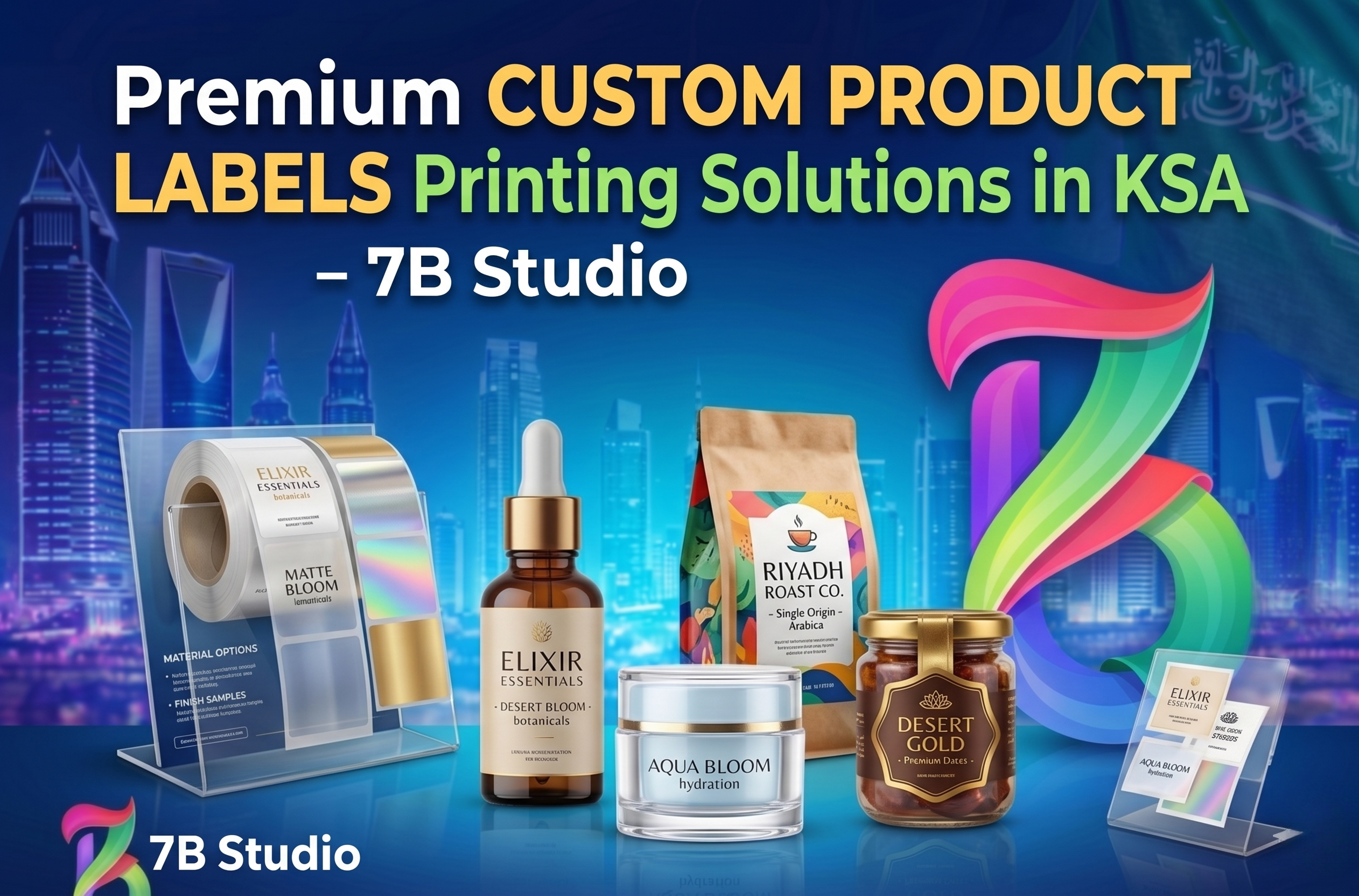
Custom Label Printing for Products in Saudi Arabia — Complete Guide (2026)
To secure high-quality custom label printing for products in Saudi Arabia, you must match the label material (like waterproof BOPP) to your specific industry, ensure strict bilingual SFDA regulatory compliance, and partner with a local manufacturer. Ordering roll labels locally prevents international shipping delays and guarantees flawless Arabic typography.
Launching a physical retail item in the Kingdom requires meticulous attention to detail. You can manufacture the absolute best cosmetic serum or artisan coffee in the region, but if the exterior sticker peels, fades, or features misspelled Arabic, consumers will immediately question the product’s safety and value. Your label is the very first interaction a customer has with your brand on a crowded supermarket shelf.
Consequently, mastering custom label printing for products is a non-negotiable requirement for retail survival. At 7b studio, we frequently rescue local startups who ordered cheap stickers from overseas, only to have their entire inventory rejected by Saudi customs due to non-compliant ingredient lists. This comprehensive 2026 guide will teach you exactly how to select the right waterproof materials, navigate strict local regulations, and source the best printing partners across Riyadh, Jeddah, and Dammam.
What Is Custom Label Printing for Products?
At its core, custom label printing for products is the specialized commercial process of producing adhesive graphics tailored entirely to your specific brand. It moves far beyond buying blank office stickers and running them through a desktop printer.
Why Product Labels Matter for Your Business
Your physical label carries the entire weight of your brand identity and legal compliance. It acts as a silent salesperson, communicating extreme luxury, organic sustainability, or clinical safety in a matter of seconds. Furthermore, a professionally printed label builds immense psychological trust, proving to the Saudi consumer that your enterprise is established and reliable.
Custom Label vs Regular Label — Key Difference
Regular labels are mass-produced, pre-sized, and highly generic, often used for simple office filing or basic shipping barcodes. Conversely, custom labels are precision-engineered. You dictate the exact die-cut shape, the specific adhesive strength (permanent vs. removable), and the premium finishes like gold foil or spot UV to match your corporate aesthetic perfectly.
Types of Custom Product Labels Available in Saudi Arabia
To protect your marketing budget, you must deliberately match the specific label substrate to the physical environment your item will face.
Paper Labels
Standard paper labels are highly cost-effective and provide a beautiful, rustic, matte finish. They are absolutely perfect for dry goods, artisan bakery boxes, and temporary retail packaging. However, they possess zero water resistance and will disintegrate instantly if exposed to moisture or heavy friction.
Waterproof & Vinyl Labels
If your item sits in a refrigerator or contains liquid, you must upgrade your raw materials. In our experience designing packaging for Saudi cosmetic lines, we strictly utilize BOPP (Biaxially Oriented Polypropylene) or vinyl labels. These premium synthetic plastics completely resist water, heavy cosmetic oils, and the intense heat of the Saudi summer without peeling or fading.
Roll Labels vs Sheet Labels
- Roll Labels: Printed continuously on a massive cardboard core. These are strictly mandatory if you utilize automated labeling machines on a fast-paced production line.
- Sheet Labels: Printed on flat A4 or A3 sheets. They are highly economical for small startups and boutique brands that manually apply stickers by hand.
Custom Sticker Labels for Packaging
Beyond the primary item, brands heavily utilize custom sticker labels to securely seal shipping boxes or wrap boutique tissue paper. Utilizing a branded sealing sticker adds a highly tactile, luxurious layer to the e-commerce unboxing experience for a fraction of a riyal.
How Custom Label Printing Works in Saudi Arabia
Executing flawless custom label printing for products requires following a strict, highly logical procurement workflow to prevent expensive prepress errors.
Step 1 — Choose Your Label Type & Size
You must physically measure your container using a flexible measuring tape to determine the exact required dimensions. Decide immediately whether you require cheap paper for dry goods or premium waterproof vinyl for liquids.
Step 2 — Design Your Product Label
Your graphic designer must build the artwork in the CMYK color space and export a fully flattened, high-resolution vector PDF. Furthermore, they must include a standard 3mm bleed area to prevent ugly white borders if the commercial cutting die shifts slightly.
Step 3 — Choose a Printing Company
Do not simply choose the absolute cheapest vendor. You must partner with a commercial facility that utilizes high-end digital or flexographic presses, offers physical material samples, and guarantees exact Pantone color matching.
Step 4 — Place Your Order (Online or In-Person)
Submit your finalized artwork and explicitly state your required finishing options, such as matte lamination or metallic foiling. If ordering roll labels, you must also specify the “unwind direction” so the labels feed correctly into your automated factory machinery.
Step 5 — Delivery & Quality Check
Upon receiving the bulk shipment, immediately inspect the rolls. Verify that the Arabic typography formats perfectly, the adhesive sticks aggressively to your specific glass or plastic containers, and the colors exactly match your corporate brand guidelines.
How to Find Custom Label Printing Companies in Saudi Arabia
What to Look for in a Label Printing Company
Before authorizing a massive commercial payment, aggressively vet the specific manufacturing facility. You absolutely need a partner who operates their heavy machinery entirely in-house, provides physical printed proofs, and holds massive local inventories of premium waterproof materials.
Online vs Local Printing — Which Is Better in KSA?
Partnering with a local Saudi factory is mathematically and logistically superior. Local vendors completely bypass unpredictable customs import delays and exorbitant ocean freight costs. Furthermore, local suppliers intimately understand complex Arabic typography and strict SFDA regulations.
Questions to Ask Before You Order
- Do you manufacture these specific labels completely in-house?
- Are your inks eco-friendly and officially certified as food-safe?
- Will you provide a physical, printed proof before running the massive bulk order?
- What is your exact policy if a roll arrives with a massive, highly visible print defect?
Red Flags to Avoid When Choosing a Printer
If a commercial supplier refuses to let you visit their physical production floor, they are likely an unreliable broker secretly outsourcing your job. Furthermore, if they cannot immediately explain the difference between paper and BOPP materials, they lack the technical expertise required for a flawless execution.
Top Label Printing Companies in Saudi Arabia
Label Printing in Riyadh
Riyadh’s massive industrial zones house world-class flexographic printing facilities capable of handling multi-million-unit runs. The capital is the absolute ideal hub for securing fast, high-volume corporate packaging procurement.
Label Printing in Jeddah
Jeddah serves as the Kingdom’s primary commercial gateway. Local printers here excel at rapid turnarounds for the FMCG and logistics sectors, frequently delivering emergency bulk orders to local food and beverage fulfillment centers.
Online Label Printing Services That Deliver in KSA
Modern digital printing portals allow agile boutique vendors to offer incredibly low minimums for startups. However, for seamless integration of structural design and flawless physical production, partnering with an established agency like 7b studio guarantees premium, stress-free results across the entire Kingdom.
Custom Label Printing for Different Product Types
Different commercial sectors demand wildly different physical properties from their packaging materials.
| Industry | Recommended Material | Key Requirement |
| Food & Beverage | White BOPP or Textured Paper | Food-safe inks, moisture resistance |
| Cosmetics & Skincare | Clear Vinyl or Metallic Foil | Oil resistance, premium luxury finish |
| Industrial Chemicals | Heavy-Duty Polyester | Extreme chemical and heat resistance |
| Retail Packaging | Standard Paper (Matte/Gloss) | High-contrast graphics, cost-efficiency |
Food & Beverage Product Labels
Consumable goods require specialized structural barriers. If your artisan juice bottles sit in ice coolers, you absolutely must utilize highly durable, waterproof synthetic plastics to prevent the graphics from disintegrating.
Cosmetic & Skincare Labels
The booming Saudi beauty sector relies heavily on “Instagrammable” aesthetics. We highly recommend utilizing clear “no-label look” materials or adding elegant gold foil stamping to instantly justify a luxury retail price point.
Industrial & Chemical Product Labels
Chemicals stored in massive warehouses face extreme environmental hostilities. Industrial labels must utilize heavy-duty polyester and aggressive, permanent adhesives to survive harsh chemical spills and blistering 50°C summer warehouse heat.
Retail & Packaging Labels
For standard dry goods, apparel tags, and shipping box seals, cost-efficiency is key. Standard gloss or matte paper provides highly vibrant, crisp graphics while aggressively protecting your daily operational overhead.
Things to Know Before Ordering Custom Labels in Saudi Arabia
Minimum Order Quantity
Industrial factories enforce Minimum Order Quantities (MOQs) to justify their heavy mechanical setup times. While traditional flexographic presses demand runs of 10,000+ units, modern digital label printers can frequently accommodate highly agile short runs starting at just 500 units.
Turnaround Time & Delivery
Standard commercial production typically requires 5 to 7 business days following your final digital artwork approval. Always buffer your logistical timeline, especially right before massive seasonal sales events like White Friday or Ramadan.
Arabic vs English Label Requirements in KSA
Designing effectively for the local demographic strictly requires a native understanding of Right-to-Left (RTL) structural flow. Your Arabic typography must be equal to or physically larger than the English text. Simply mirroring an English template frequently results in highly confusing, illegal layouts.
Saudi SFDA Labeling Compliance (Food & Cosmetics)
The Saudi Food and Drug Authority (SFDA) rigorously enforces strict technical specifications. You must prominently display all mandatory ingredient lists, expiration dates, and country of origin data in flawless Arabic. Failing a sudden SFDA packaging audit results in immediate, catastrophic product recalls.
Are you ready to elevate your brand with flawless, compliant physical presentation? Partner with the commercial manufacturing experts at 7b studio today for world-class custom label printing for products that commands immediate consumer respect and protects your bottom line.
FAQs — Custom Label Printing in Saudi Arabia
1. Where can I print custom labels for products in Saudi Arabia?
You can source premium labels from major industrial zones in Riyadh, Jeddah, and Dammam. For the most streamlined, high-quality experience, partnering with specialized commercial branding and print agencies like 7b studio guarantees exceptional results.
2. Can I order custom labels online and get delivery in KSA?
Yes, absolutely. Many local and regional digital printing portals allow you to seamlessly upload your artwork online and offer rapid, secure courier delivery directly to your warehouse anywhere in the Kingdom.
3. What is the minimum order for custom label printing in Saudi Arabia?
For highly economical traditional flexo printing, MOQs typically start around 5,000 to 10,000 units. However, many modern digital printing facilities cater specifically to startups, offering agile short runs starting at just 250 or 500 units.
4. Are there Arabic label printing services in Saudi Arabia?
Yes. Reputable local Saudi manufacturers employ native prepress technicians who flawlessly handle dual-language, Right-to-Left (RTL) structural layouts, ensuring your Arabic typography formats perfectly and legally.
5. What is the best waterproof label material for cosmetic bottles?
BOPP (Biaxially Oriented Polypropylene) and commercial vinyl are the undisputed best materials for cosmetics. They completely resist water, heavy essential oils, and friction, ensuring your branding never smears or peels in a bathroom environment.
6. Do I need to supply my artwork in CMYK or RGB?
Commercial printing presses require absolute digital perfection. You must strictly convert your digital files to the CMYK color space before submission to prevent your vibrant brand colors from looking dull and muddy on the press.
7. What does “unwind direction” mean for roll labels?
The unwind direction specifies exactly which way the labels come off the roll (e.g., top first, bottom first, left side first). This is a strictly mandatory setting if you are using an automated machine to apply the labels to your bottles.
8. Does the SFDA require my cosmetic label to be in Arabic?
Yes, absolutely. The Saudi Food and Drug Authority (SFDA) legally mandates that all primary product information, usage instructions, and safety warnings must be prominently displayed in clear, highly accurate Arabic text.
9. Can I get gold foil or metallic finishes on my custom labels?
Yes. Premium commercial manufacturers offer high-end finishing upgrades like hot foil stamping (gold, silver, rose gold), spot UV gloss, and soft-touch matte lamination to drastically elevate your brand’s luxury appeal.
10. How do I prevent my custom labels from bubbling when applied?
To prevent ugly air bubbles, you must ensure your container surface is completely clean and dry before application. Furthermore, always apply the label slowly from the center outward, utilizing a squeegee tool to force trapped air out the sides.
Post a Comment